What Is a Personal Budget?
A personal budget is a written financial plan that shows how much money you earn and exactly how you plan to spend and save it each month. It's the foundation of every healthy financial life.
The word "budget" feels restrictive to a lot of people — like a diet for your money. But a good budget doesn't stop you from spending on things you enjoy. It simply makes sure your spending is intentional, not accidental.
Without a budget, most people have no idea where their money goes. They earn a decent income and still feel broke at the end of the month. A budget fixes that.
Why Budgeting Matters
- What Is a Personal Budget?
- Why Budgeting Matters
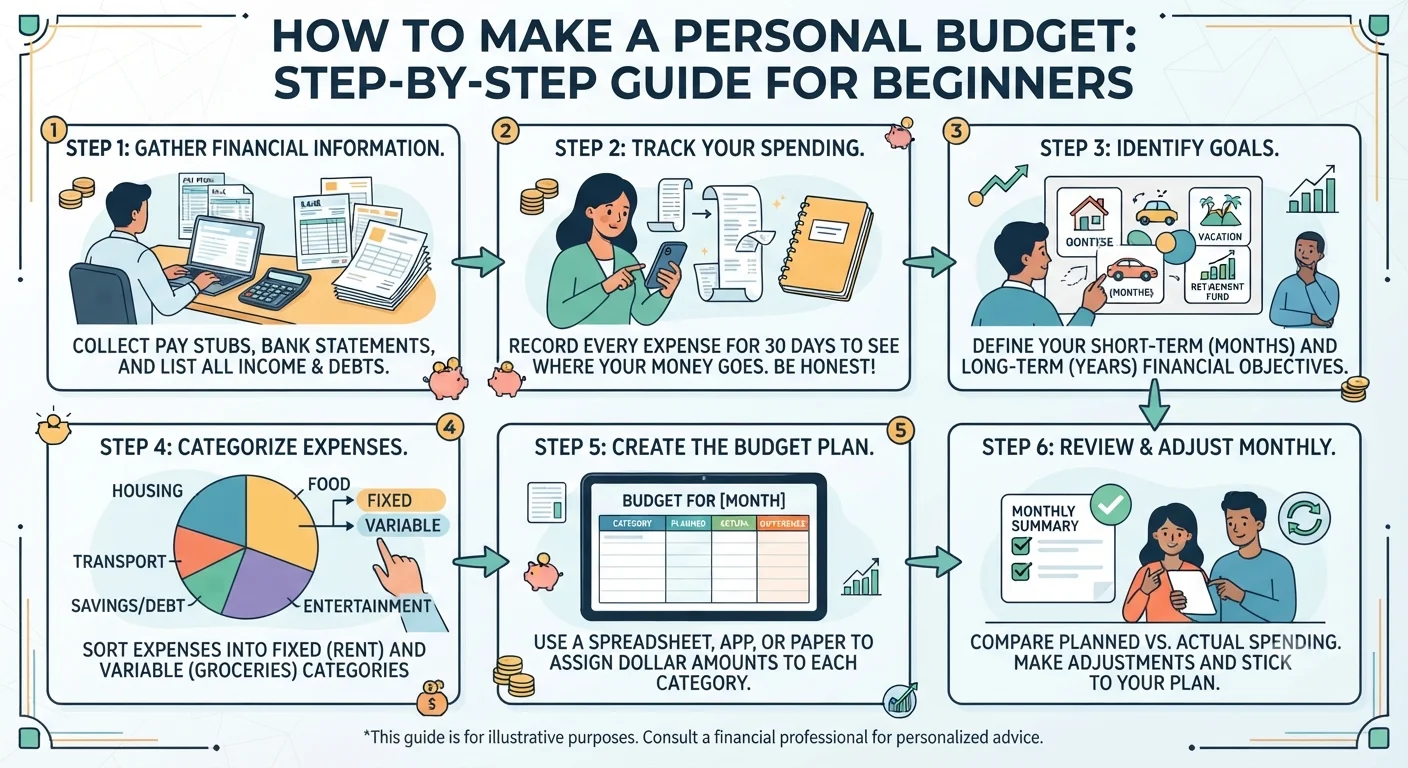
- How to Make a Personal Budget: Step by Step
- Step 1: Calculate Your Total Monthly Income
- Step 2: List All Your Monthly Expenses
- Step 3: Subtract Expenses from Income
- Step 4: Choose a Budgeting Method
- Step 5: Set Clear Savings Goals
- Step 6: Track Your Spending
- Step 7: Review and Adjust Monthly
- Common Budgeting Mistakes to Avoid
- Budgeting by Income Level
- Budget on ,000/Month (After Tax)
- Budget on ,000/Month (After Tax)
- Budget on ,000/Month (After Tax)
- Best Free Budgeting Tools in 2025
- Frequently Asked Questions (FAQ)
- Conclusion
Here's the honest truth: without a budget, you are making financial decisions blindly. Consider these facts:
- Nearly 60% of Americans don't have enough savings to cover a $1,000 emergency.
- The average American spends $18,000 per year on non-essential purchases.
- People with a written budget save roughly 20% more than those without one.
A budget helps you:
- Eliminate wasteful spending you didn't even realize you were doing
- Build an emergency fund faster
- Pay off debt with a clear strategy
- Save consistently for retirement, a home, or a vacation
- Reduce financial stress and anxiety
How to Make a Personal Budget: Step by Step
Step 1: Calculate Your Total Monthly Income
Start with every dollar coming in after taxes (your take-home pay). Include:
- Your primary salary or wages (after tax)
- Freelance or side hustle income
- Rental income
- Child support or alimony received
- Government benefits
- Any other regular income
Use the average if your income varies month to month. If it's unpredictable, budget based on your lowest expected monthly income to stay conservative.
Example: Take-home pay $3,200 + side freelance income $400 = Total: $3,600/month
Step 2: List All Your Monthly Expenses
Write down every single expense. Split them into two groups:
Fixed expenses (same amount every month):
- Rent or mortgage
- Car payment
- Insurance premiums (health, auto, renters)
- Loan repayments
- Subscriptions (Netflix, Spotify, gym)
Variable expenses (change month to month):
- Groceries
- Utilities (electricity, water, internet)
- Gas / transportation
- Dining out
- Clothing
- Entertainment
- Personal care
One-time or irregular expenses (annual, quarterly):
- Car registration
- Annual subscriptions
- Holiday gifts
- Medical expenses
For variable expenses, look at your last 2–3 months of bank and credit card statements to find your real average. Don't guess — the numbers will surprise you.
Step 3: Subtract Expenses from Income
Now do the simple math:
Total income − Total expenses = Budget surplus or deficit
- Surplus (positive number): You have money left over. This goes to savings, investments, or extra debt payments.
- Deficit (negative number): You're spending more than you earn. This is urgent — you need to cut expenses or increase income.
Step 4: Choose a Budgeting Method
There are several proven approaches. Choose the one that fits your personality:
The 50/30/20 Rule (Best for Beginners)
- 50% of income → Needs (rent, groceries, utilities, insurance, minimum debt payments)
- 30% of income → Wants (dining out, entertainment, subscriptions, hobbies)
- 20% of income → Savings and debt payoff (emergency fund, retirement, extra debt payments)
Example on $3,600/month income:
- Needs: $1,800
- Wants: $1,080
- Savings/Debt: $720
Zero-Based Budgeting
Assign every dollar a job until your income minus expenses equals zero. Every dollar is accounted for — you don't have leftover money sitting around being spent unconsciously. Best for people who want maximum control.
Envelope Budgeting
Withdraw cash and put it in labeled envelopes (groceries, gas, dining). When an envelope is empty, spending stops for that category. Very effective for overspending categories but less practical in a card-based world.
Pay-Yourself-First
Automatically transfer your savings goal to a savings or investment account the moment you get paid. Then spend the rest freely. Simple and effective for people who hate detailed tracking.
Step 5: Set Clear Savings Goals
Every budget needs a "why." Define your savings goals and assign amounts to each:
| Goal | Monthly Amount | Timeline |
|---|---|---|
| Emergency fund (3–6 months expenses) | $300 | 18 months |
| Vacation | $100 | 12 months |
| Car down payment | $200 | 24 months |
| Retirement (401k/IRA) | $200 | Ongoing |
| Total savings | $800 | — |
Treat savings as a non-negotiable expense, not something you do with "whatever's left."
Step 6: Track Your Spending
A budget is useless if you set it and forget it. Track your actual spending throughout the month and compare it to your plan.
Recommended Articles
 PERSONAL FINANCE
 PERSONAL FINANCE
Methods to track spending:
- Free apps: Mint, YNAB (You Need a Budget), EveryDollar, Copilot Money
- Spreadsheet: Google Sheets or Excel with a simple template
- Pen and paper: Old-school but works if you're consistent
- Bank app: Most banks now offer basic spending categorization
Check your spending at least once per week. It takes 5 minutes and keeps you accountable.
Step 7: Review and Adjust Monthly
On the last day of every month, review how you did:
- Did you stay in budget for each category?
- Were there unexpected expenses? Where did the money actually come from?
- What do you need to adjust next month?
Your budget will change as your life changes — new job, new baby, moving to a new city. That's normal. The goal is not a perfect budget; it's the habit of planning your money.
Common Budgeting Mistakes to Avoid
Forgetting irregular expenses: Car maintenance, medical bills, and holiday gifts don't happen every month, but they will happen. Add a "miscellaneous" or "irregular expenses" category and fund it monthly.
Setting unrealistic spending limits: If you normally spend $600/month on food, budgeting $200 will fail immediately. Start with realistic numbers and tighten gradually.
Not accounting for fun: A budget that allows zero discretionary spending will be abandoned within two weeks. Build in an "enjoy life" category — even $50–$100/month makes the budget sustainable.
Giving up after one bad month: Everyone blows their budget occasionally. The solution is to reset and start the next month fresh, not to quit budgeting entirely.
Ignoring small subscriptions: The average American pays for 12 subscription services but actively uses only 6. These "invisible expenses" drain hundreds per year.
Budgeting by Income Level
Budget on $2,000/Month (After Tax)
- Needs (50%): $1,000
- Wants (30%): $600
- Savings (20%): $400
Priority: Build a $1,000 emergency fund first, then focus on debt.
Budget on $4,000/Month (After Tax)
- Needs (50%): $2,000
- Wants (30%): $1,200
- Savings (20%): $800
Priority: Max employer 401(k) match, build 3-month emergency fund, pay off high-interest debt.
Budget on $7,000/Month (After Tax)
- Needs (50%): $3,500
- Wants (30%): $2,100
- Savings (20%): $1,400
Priority: Max retirement accounts, invest in taxable brokerage, plan for large purchases.
Best Free Budgeting Tools in 2025
- YNAB (You Need a Budget): Best for zero-based budgeting. Free for 34 days, then $14.99/month or $99/year.
- Mint: Free, automatic expense tracking and budget categories.
- EveryDollar: Dave Ramsey's zero-based budget app. Free basic version available.
- Google Sheets Budget Template: Free, customizable, works anywhere.
- Copilot Money: Clean UI, AI-assisted categorization. $13/month, iOS only.
- Personal Capital (Empower): Free net worth tracking and investment overview, great alongside a budget app.
Frequently Asked Questions (FAQ)
What is a personal budget and why do I need one? A personal budget is a monthly plan that shows how you'll earn, spend, and save your money. You need one because without a plan, spending happens by habit and impulse rather than intention — which is why so many people with good incomes still end up living paycheck to paycheck.
How do I start a budget with no money? Start by tracking everything you spend for 30 days without changing anything. That gives you a clear picture of where your money currently goes. Then identify 2–3 spending categories you can reduce and redirect that money to an emergency fund. Even $25/week builds to $1,300 in a year.
What is the best budgeting method for beginners? The 50/30/20 rule is the most beginner-friendly approach because it's simple, flexible, and doesn't require tracking every dollar obsessively. Once you're comfortable with the basics, you can move to zero-based budgeting for more control.
How often should I review my budget? Track spending at least weekly, and do a full monthly review on the last day of each month. Also revisit your budget whenever there's a major change — new income, a move, a new baby, a job change.
Is budgeting worth it if I'm already in debt? Budgeting is especially important when you're in debt. A budget is what allows you to find extra money to accelerate debt payoff. Most people discover they can free up $200–$500/month simply by identifying and cutting wasteful spending they hadn't noticed.
What percentage of income should go to rent? Financial experts generally recommend keeping housing costs (rent or mortgage + utilities) below 30% of your gross income. Ideally, keep it under 25% to leave more room for savings and discretionary spending.
Conclusion
Making a personal budget is one of the most powerful things you can do for your financial life. It doesn't have to be complicated — start with your income, list your expenses, pick a method that fits you, and check in regularly. The key is starting, even imperfectly.
Your first budget won't be perfect. That's fine. What matters is building the habit of telling your money where to go instead of wondering where it went.
Disclaimer: The content on this site is for educational and informational purposes only and does not constitute personalized financial advice. Consult a licensed financial professional for advice tailored to your situation.