Introduction: Why This Distinction Matters
If you've ever Googled "get help with money," you've probably noticed a confusing swirl of titles: financial advisor, financial planner, financial consultant, wealth manager, investment advisor, money coach, financial counselor.
What does each title actually mean? And which type of professional do you actually need?
The short answer: the title matters less than you think. What matters is whether the person is a fiduciary, what credentials they hold, and what specific services they provide.
That said, understanding the difference between a financial advisor and a financial planner helps you ask the right questions and hire the right person for your situation.
What Is a Financial Advisor?
- Introduction: Why This Distinction Matters
- What Is a Financial Advisor?
- What Is a Financial Planner?
- What Is a Certified Financial Planner (CFP)?
- Financial Advisor vs. Financial Planner: Side-by-Side Comparison
- What Other Financial Professional Titles Mean
- Registered Investment Advisor (RIA)
- Wealth Manager
- Investment Advisor
- Financial Consultant
- Financial Coach / Money Coach
- Financial Counselor / AFC
- The Most Important Question: Are You a Fiduciary?
- Which Type of Professional Do You Need?
- You need a Certified Financial Planner (CFP) if:
- You need an Investment Advisor / Portfolio Manager if:
- A Robo-Advisor may work if:
- A Financial Coach may work if:
- How to Verify a Financial Professional's Credentials
- Frequently Asked Questions (FAQ)
- Conclusion
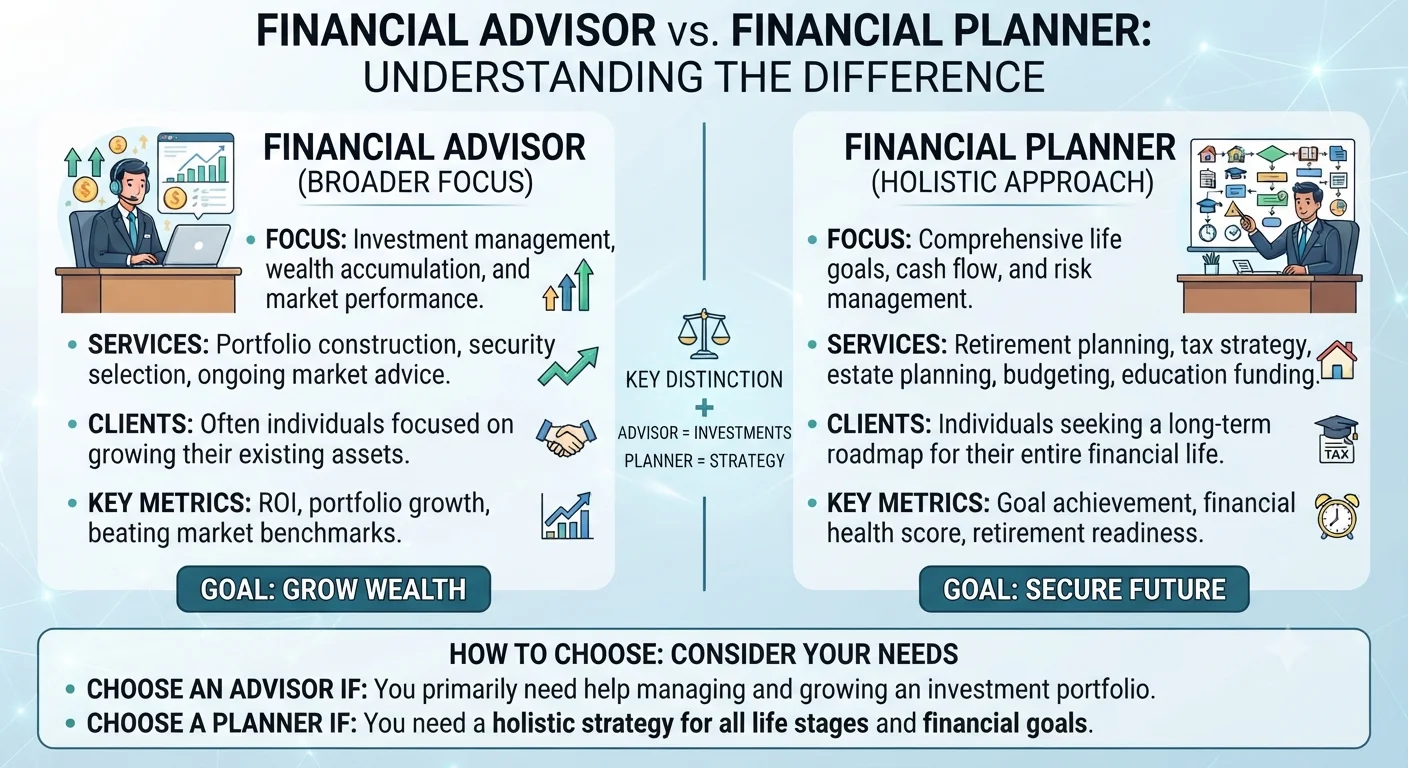
"Financial advisor" is an umbrella term. It has no legal definition in the United States, which means virtually anyone in the financial services industry can call themselves a financial advisor — stockbrokers, insurance agents, investment managers, and more.
When someone calls themselves a financial advisor, they might:
- Manage investment portfolios
- Sell insurance and annuity products
- Execute trades in a brokerage account
- Provide general money guidance
- Create retirement projections
Because the term is so broad, you need to dig deeper — ask about their credentials, how they're compensated, and whether they're a fiduciary.
What Is a Financial Planner?
A financial planner is a type of financial advisor who specializes in creating comprehensive financial plans. Where an advisor might focus on a specific area (like investments), a financial planner takes a holistic view of your entire financial life.
A financial plan typically covers:
- Current financial assessment (income, assets, debts, insurance)
- Short-term and long-term goal setting
- Cash flow and budgeting analysis
- Investment strategy
- Retirement projections
- Tax planning overview
- Insurance needs analysis
- Estate planning basics
A financial planner's output is usually a detailed written document — the financial plan — that serves as your financial roadmap.
What Is a Certified Financial Planner (CFP)?
A Certified Financial Planner (CFP) is a financial planner who has earned the most widely recognized credential in the profession.
To earn the CFP designation, a professional must:
- Complete a CFP Board-approved education program
- Pass a rigorous 170-question, 6-hour exam
- Accumulate 6,000 hours of professional financial planning experience (or 4,000 hours in an apprenticeship program)
- Agree to uphold the CFP Board's Code of Ethics
- Complete 30 hours of continuing education every two years
CFPs are required to act as fiduciaries when providing financial planning services — meaning they must put your interests first, not their own.
Bottom line: If you want holistic, comprehensive financial planning from a credentialed professional who has proven competency, a CFP is the best starting point.
Financial Advisor vs. Financial Planner: Side-by-Side Comparison
| Financial Advisor | Financial Planner | |
|---|---|---|
| Regulated title? | No — anyone can use it | No — but CFP designation is regulated |
| Primary focus | Often investments or products | Comprehensive financial picture |
| Key credential | CFA, ChFC, or none required | CFP (gold standard) |
| Fiduciary requirement | Varies — not always | CFPs must be fiduciaries during planning |
| Output | Portfolio management, product recommendations | Written financial plan |
| Compensation | AUM fees, commissions, or flat fees | Hourly, flat fee, or AUM |
| Best for | Investment management, specific advice | Comprehensive guidance across all areas |
What Other Financial Professional Titles Mean
Since the terminology is genuinely confusing, here's a quick reference:
Registered Investment Advisor (RIA)
An RIA is a firm or individual registered with the SEC or a state regulator to provide investment advice. RIAs are required to be fiduciaries. Many financial advisors and financial planners operate as RIAs.
Wealth Manager
A wealth manager serves high-net-worth clients (typically $1M+ in investable assets) and provides a very comprehensive suite of services: investment management, tax strategy, estate planning, charitable giving, and more. Essentially a full-service financial advisor for the wealthy.
Investment Advisor
Focuses primarily on investment management — building and managing portfolios. May or may not provide broader financial planning.
Financial Consultant
Often a sales-oriented title used by brokerage firms. May sell products. Always ask about compensation.
Financial Coach / Money Coach
Not a regulated title. Money coaches typically help with behavioral and mindset aspects of money — budgeting, spending habits, financial confidence. They generally do not manage investments or provide legal/tax advice.
Recommended Articles
 PERSONAL FINANCE
 PERSONAL FINANCE
Financial Counselor / AFC
An Accredited Financial Counselor (AFC) focuses on financial wellness, budgeting, debt management, and credit — often working with people in financial hardship or the military community.
The Most Important Question: Are You a Fiduciary?
Here's the question that matters more than any job title:
"Are you a fiduciary at all times when advising me?"
A fiduciary is legally required to act in your best interest. A non-fiduciary only needs to recommend something "suitable" — which might still benefit the advisor more than it benefits you.
Here's why this matters practically:
Imagine two advisors both recommend mutual funds for your retirement account. Advisor A recommends a low-cost index fund with a 0.05% expense ratio. Advisor B recommends an actively managed fund with a 1.2% expense ratio — but earns a commission on it.
Both recommendations might be "suitable." But only one is clearly in your best interest. Advisor A is behaving as a fiduciary. Advisor B may not be.
Always ask. Always get it in writing.
Which Type of Professional Do You Need?
Here's a simple guide based on your situation:
You need a Certified Financial Planner (CFP) if:
- You want a comprehensive financial plan covering multiple areas of your life
- You have a major life event coming up (marriage, new baby, home purchase, divorce, inheritance)
- You're within 10 years of retirement and need a detailed drawdown strategy
- You're a business owner with complex financial needs
- You simply want one trusted advisor to coordinate everything
You need an Investment Advisor / Portfolio Manager if:
- You already have a financial plan and just need someone to manage your investments
- You have $250,000+ to invest and want active portfolio management
A Robo-Advisor may work if:
- You're early in your career with simple finances
- You want low-cost, hands-off investment management
- You have less than $50,000 to invest
A Financial Coach may work if:
- You're working on budgeting skills, debt mindset, or building healthy money habits
- You don't yet have significant investable assets
- You want accountability and behavioral guidance rather than investment management
How to Verify a Financial Professional's Credentials
Before hiring anyone:
- CFP verification: Check the CFP Board's website at cfp.net/verify
- Investment advisor registration: Check the SEC's IAPD at adviserinfo.sec.gov
- Broker background: Check FINRA BrokerCheck at brokercheck.finra.org
- Disciplinary history: All three resources above show complaints and disciplinary actions
Red flags to watch for:
- Guarantees of investment returns (illegal)
- Pressure to act quickly without time to review
- Refusing to clarify their compensation in writing
- Not willing to confirm fiduciary status
- Unlicensed or unable to verify credentials
Frequently Asked Questions (FAQ)
Is a financial planner the same as a financial advisor? Not exactly. A financial advisor is a broad term covering anyone who gives financial guidance. A financial planner specifically focuses on creating a comprehensive, written plan for your entire financial life. A Certified Financial Planner (CFP) is the gold-standard credential for financial planners.
Do I need a financial advisor or a financial planner? If you need help with one specific area — like managing investments — a financial advisor may be enough. If you want a holistic strategy covering budgeting, investing, taxes, insurance, and retirement together, you want a financial planner, ideally a CFP.
What is a fiduciary financial advisor? A fiduciary financial advisor is legally required to act in your best interest at all times. Fee-only advisors registered as RIAs are typically fiduciaries. Always confirm fiduciary status in writing before working with any financial professional.
How do I find a fee-only financial planner? The NAPFA (National Association of Personal Financial Advisors) at napfa.org maintains a directory of fee-only, fiduciary financial planners. The Garrett Planning Network (garrettplanningnetwork.com) connects clients with hourly-rate financial planners — useful if you don't want ongoing advisory fees.
What credentials should a financial planner have? The CFP (Certified Financial Planner) is the most rigorous and widely recognized credential. Other solid credentials include the ChFC (Chartered Financial Consultant) and CFA (Chartered Financial Analyst). Be cautious of self-invented designations that lack third-party oversight.
Can a financial advisor also be a financial planner? Yes — many professionals serve both roles. A CFP who manages investment portfolios is both a financial planner and a financial advisor. The distinction is about what services they emphasize, not a strict either/or classification.
Conclusion
The difference between a financial advisor and a financial planner comes down to scope and credentials. A financial planner — specifically a CFP — takes a comprehensive, holistic view of your financial life and creates a written roadmap. A financial advisor is a broader term that may or may not involve comprehensive planning.
What matters most isn't the title on their business card. Ask about their credentials, confirm they're a fiduciary, and understand exactly how they're compensated. That's how you find someone truly working in your interest.
Disclaimer: This article is for educational purposes only and does not constitute personalized financial or legal advice. Always consult a licensed financial professional before making major financial decisions.