What Is Financial Advisory?
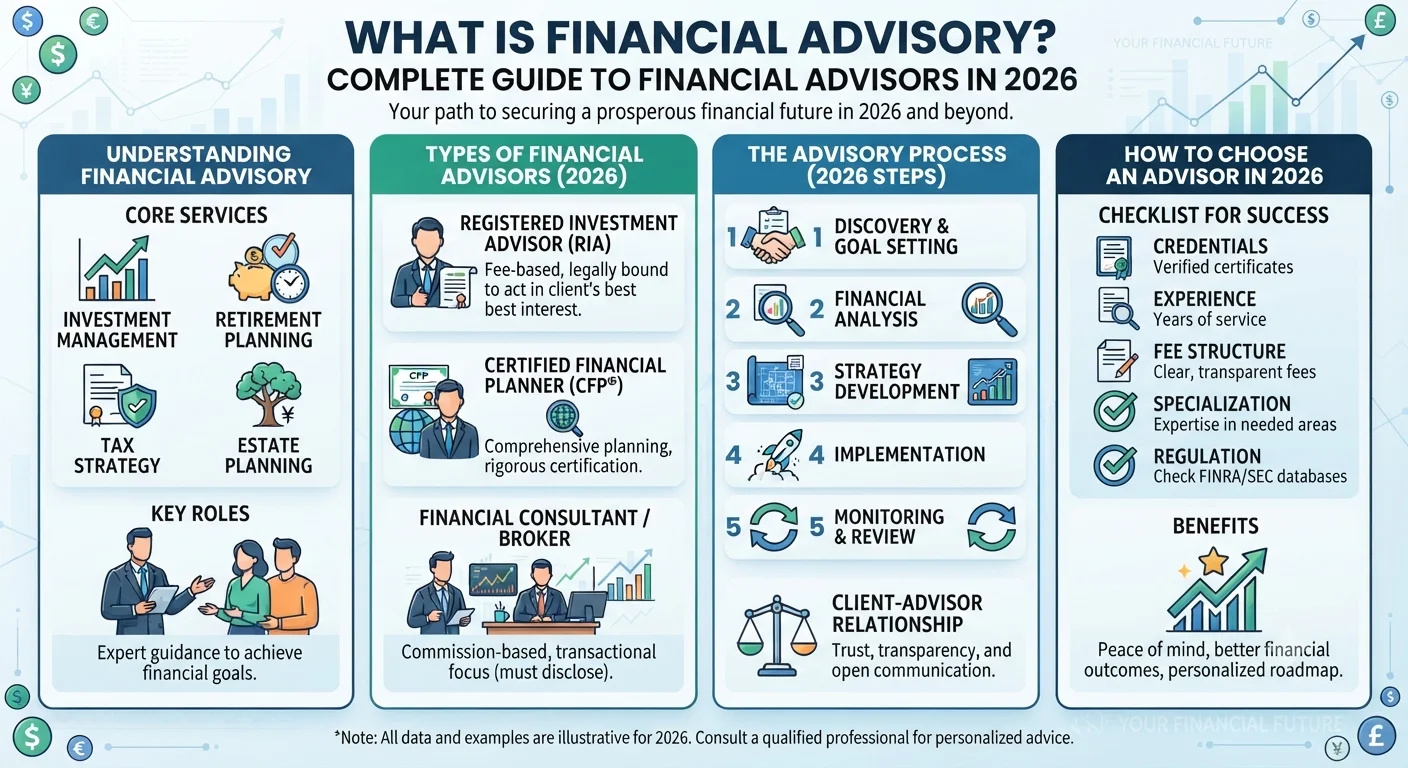
Financial advisory is the professional service of providing personalized guidance on financial matters — including budgeting, saving, investing, tax planning, retirement, and estate planning.
A financial advisor (also spelled financial adviser) is the person who delivers this service. They analyze your financial situation, understand your goals, and create a strategy to help you achieve them.
Think of a financial advisor the way you'd think of a doctor: just as you wouldn't diagnose a serious health condition yourself, it makes sense to get a professional opinion on major financial decisions — especially ones that affect your long-term security.
Financial advisory services are used by:
- Individuals and families planning for retirement
- Small business owners managing cash flow and taxes
- Young professionals building their first investment portfolio
- High-net-worth individuals managing complex estates
- Anyone facing a major financial event (inheritance, divorce, home purchase, job loss)
How Does Financial Advisory Work?
- What Is Financial Advisory?
- How Does Financial Advisory Work?
- Step 1: Initial Consultation
- Step 2: Financial Assessment
- Step 3: Goal Setting
- Step 4: Financial Plan Creation
- Step 5: Implementation
- Step 6: Ongoing Review
- Types of Financial Advisors
- 1. Fiduciary Financial Advisor
- 2. Broker-Dealer / Financial Representative
- 3. Certified Financial Planner (CFP)
- 4. Wealth Manager
- 5. Robo-Advisor
- 6. Retirement Planner
- 7. Tax Advisor / CPA
- What Does a Financial Advisor Do?
- How Much Does a Financial Advisor Cost?
- Fee-Only (Recommended)
- Commission-Based
- Fee-Based (Hybrid)
- Robo-Advisors
- Do You Need a Financial Advisor?
- How to Find a Financial Advisor You Can Trust
- Financial Advisory vs. Financial Planning: What's the Difference?
- Frequently Asked Questions (FAQ)
- Conclusion
The financial advisory process typically follows these steps:
Step 1: Initial Consultation
Most advisors offer a free first meeting. You'll discuss your financial situation, goals, timeline, and concerns. This is where you decide if the advisor is a good fit.
Step 2: Financial Assessment
Your advisor reviews your income, expenses, debts, assets, insurance policies, and existing investments. They get a complete picture of where you stand today.
Step 3: Goal Setting
Together, you define clear financial goals — both short-term (pay off debt, build emergency fund) and long-term (retire at 60, fund children's education, buy a home).
Step 4: Financial Plan Creation
Your advisor builds a personalized plan with specific recommendations. This might include an investment strategy, a savings schedule, a tax-reduction approach, and an insurance review.
Step 5: Implementation
You execute the plan — opening accounts, adjusting investments, updating beneficiaries, or restructuring debt.
Step 6: Ongoing Review
Good financial advisory is not a one-time event. Your advisor checks in regularly (quarterly or annually) to adjust the plan as your life changes.
Types of Financial Advisors
Not all financial advisors are the same. Here's a breakdown of the most common types:
1. Fiduciary Financial Advisor
A fiduciary is legally required to act in your best interest at all times. This is the gold standard. Fee-only advisors who are registered investment advisors (RIAs) are typically fiduciaries.
2. Broker-Dealer / Financial Representative
These advisors work for brokerage firms and are held to a "suitability standard" — they only need to recommend products that are suitable for you, not necessarily the best option. Be aware that many earn commissions on products they sell.
3. Certified Financial Planner (CFP)
A CFP has passed a rigorous exam, completed thousands of hours of experience, and is held to ethical standards. CFPs can advise on a wide range of financial topics.
4. Wealth Manager
Wealth managers serve high-net-worth clients (typically $1M+ in investable assets) and offer comprehensive services including investment management, tax strategy, estate planning, and legal coordination.
5. Robo-Advisor
A robo-advisor is an automated platform (like Betterment, Wealthfront, or Vanguard Digital Advisor) that builds and manages a diversified investment portfolio based on your risk tolerance and goals. Low cost, but no human relationship.
6. Retirement Planner
Specialists in retirement income planning — how to draw down savings, optimize Social Security, manage required minimum distributions (RMDs), and plan for healthcare costs in retirement.
7. Tax Advisor / CPA
Focuses specifically on minimizing your tax burden. Works closely with your financial planner for coordinated tax strategy.
What Does a Financial Advisor Do?
A financial advisor can help you with:
| Service | What It Means |
|---|---|
| Investment management | Building and managing a portfolio of stocks, bonds, ETFs, and other assets |
| Retirement planning | Estimating how much you need and building a strategy to get there |
| Tax planning | Reducing what you owe legally through deductions, deferrals, and smart account use |
| Budgeting & cash flow | Getting your income and expenses aligned with your goals |
| Insurance review | Making sure you're properly covered without overpaying |
| Estate planning | Planning how your wealth transfers to heirs efficiently |
| Debt management | Creating a strategy to pay down debt in the right order |
| College savings | Setting up 529 plans and calculating how much to save |
| Business planning | Helping entrepreneurs with business structure, exit planning, and succession |
How Much Does a Financial Advisor Cost?
Understanding advisor fees is critical before hiring one. Here are the main fee structures:
Recommended Articles
 PERSONAL FINANCE
 PERSONAL FINANCE
Fee-Only (Recommended)
The advisor charges you directly — no commissions. This eliminates conflicts of interest.
- Hourly rate: $150–$400/hour
- Flat fee: $1,000–$5,000 for a one-time financial plan
- Retainer: $2,000–$10,000/year for ongoing advice
- AUM fee: 0.5%–1.5% of your assets under management per year
Commission-Based
The advisor earns money when you buy financial products (mutual funds, insurance, annuities). This creates potential conflicts of interest.
Fee-Based (Hybrid)
A combination of direct fees and commissions. Be sure to ask what commissions they earn so you can evaluate any bias.
Robo-Advisors
Typically charge 0.25%–0.50% of AUM per year — a fraction of the cost of a human advisor.
Do You Need a Financial Advisor?
You might benefit from a financial advisor if you:
- Don't have a clear retirement plan
- Have recently experienced a major life event (marriage, divorce, new baby, inheritance)
- Are confused about investing and don't know where to start
- Want to reduce your tax bill but don't know how
- Are starting or selling a business
- Have significant debt and no plan to pay it off
- Feel anxious about money and want professional guidance
You might not need one yet if you:
- Are just starting out and have simple finances
- Are comfortable using low-cost index funds and managing your own portfolio
- Have very limited income with no investment assets yet (a robo-advisor may suffice)
How to Find a Financial Advisor You Can Trust
Follow these steps when searching for an advisor:
- Start with referrals — ask family, friends, or colleagues who they trust.
- Check credentials — look for CFP, CFA, ChFC, or CPA designations.
- Verify registration — check FINRA BrokerCheck or the SEC's Investment Advisor Search.
- Ask if they're a fiduciary — get it in writing.
- Understand their fee structure — ask for a written breakdown of all costs.
- Interview multiple advisors — most offer free first consultations.
- Check for complaints — look up their disciplinary history on FINRA.
Financial Advisory vs. Financial Planning: What's the Difference?
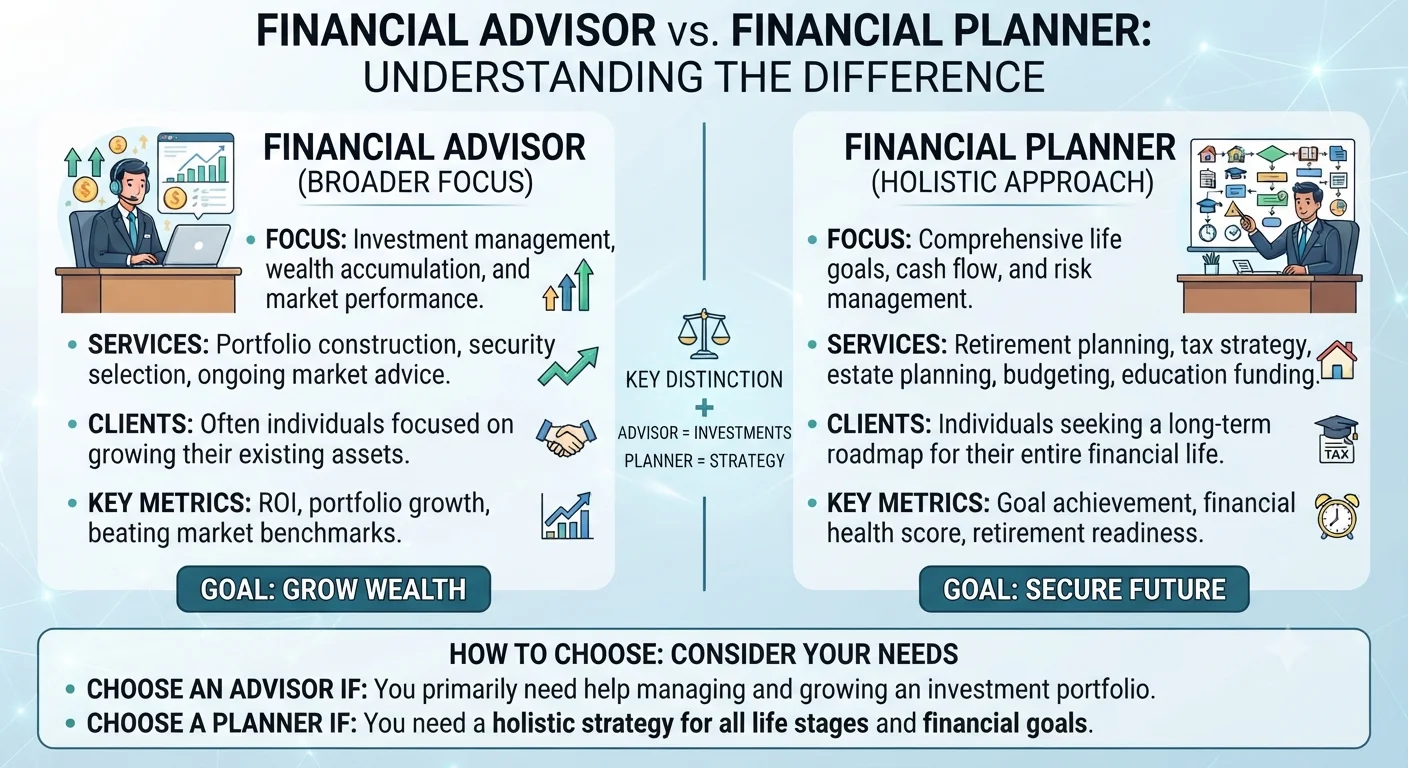
These terms are often used interchangeably, but there's a subtle distinction:
- Financial planning is the process of creating a comprehensive financial roadmap — budgeting, retirement projections, insurance needs, estate plan.
- Financial advisory is broader and ongoing — it includes executing the plan, managing investments, and adjusting strategy as your life evolves.
In practice, most financial advisors provide both services.
Frequently Asked Questions (FAQ)
What is a financial advisor? A financial advisor is a licensed professional who provides guidance on money management, including investing, retirement, taxes, insurance, and estate planning. They help individuals and businesses make informed financial decisions aligned with their goals.
How do I know if a financial advisor is a fiduciary? Ask them directly: "Are you a fiduciary at all times?" Get the answer in writing. You can also check if they are a Registered Investment Advisor (RIA) with the SEC, which requires fiduciary duty.
How much should I pay a financial advisor? A reasonable fee for ongoing advisory services is 1% of assets under management per year or less. For a one-time financial plan, expect to pay $1,000–$3,000. Avoid advisors who charge much more without clear justification.
Can a financial advisor help me get out of debt? Yes. Many financial advisors help clients create debt payoff strategies alongside their investment and savings plans. Some specialize specifically in debt management.
Is it worth hiring a financial advisor? Research consistently shows that people who work with financial advisors accumulate significantly more wealth over time than those who don't — largely because advisors help clients avoid emotional investment mistakes, reduce taxes, and stay on track. For most people, the cost is worth it.
What's the difference between a financial advisor and a stockbroker? A stockbroker executes trades on your behalf and may earn commissions. A financial advisor takes a holistic view of your finances and typically provides comprehensive planning across multiple areas — not just investments.
At what net worth should I get a financial advisor? You don't need to be wealthy. Many advisors work with people at all income levels. That said, if you have less than $10,000 to invest, a robo-advisor may be more cost-effective for investment management while you build wealth.
Conclusion
Financial advisory is one of the most valuable services you can invest in. Whether you're just starting your financial journey or managing complex wealth, the right advisor gives you a clear plan, helps you avoid costly mistakes, and keeps you on track toward your most important goals.
At West Pacific Advisors, our mission is to give you the knowledge and tools to make confident financial decisions — whether you work with an advisor or manage your finances independently. Browse our guides, use our calculators, and take control of your financial future.
Disclaimer: The content on this site is for educational and informational purposes only. It does not constitute personalized financial advice. Please consult a licensed financial professional before making any financial decisions.